

The Novare Growth RIHF (Retail Investment Hedge Fund) is a retail hedge fund investing across a wide range of instruments, seeking strong performance while preserving capital. Returns are primarily generated through JSE-listed equities across all sectors. The portfolio aims for stable returns with low correlation to the JSE through disciplined risk management and long-term investing.
Why Invest in Hedge Funds?
Hedge funds are often perceived as high-risk investments operating within lightly regulated environments, which can make investors hesitant to invest in them. In South Africa, however, hedge funds are subject to a robust regulatory framework, presenting a very different picture from the perception many investors may hold. While high-risk hedge funds do exist locally, most Retail Investor Hedge Funds (RIHFs) focus on preserving investor capital while still aiming to deliver equity-related returns.
One of the key advantages hedge funds have over traditional unit trust funds is their ability to invest in a broader range of instruments and implement more flexible investment strategies. This flexibility allows hedge funds to potentially generate stronger returns during bear (negative) market conditions compared to unit trusts. In theory, this means that hedge funds should be better positioned to outperform traditional unit trust funds during periods of declining equity markets.
Hedge Fund Types
Retail Investment Hedge Funds (RIHFs)
These funds are designed for the public to invest in and are subject to stricter regulatory limits. Retail hedge funds are more liquid, making disinvestment much easier, have lower minimum investment amounts and greater transparency to the investors and the public.
Qualified Investment Hedge Funds (QIHFs)
These funds are for more sophisticated investors, as the minimum investment amount is much higher, the funds tend to have a higher risk tolerance and have less liquidity, making it more difficult to disinvest from some of these funds.
Hedge Fund Categories
Within the two hedge fund structures, managers typically operate across several established investment categories. The three most common hedge fund categories in South Africa are:
Equity long/short funds
The most widely used hedge fund strategy in South Africa. These funds take both long and short positions in shares to generate returns while managing market risk.
Market Neutral Funds
These funds aim to minimise overall market exposure by balancing long and short positions, reducing dependence on general market direction.
Multi-Strategy Funds
Multi-strategy funds combine various asset classes and investment approaches, including equities, fixed income, derivatives, and arbitrage strategies, to optimise returns across different market conditions.
Why Us? (Performance)
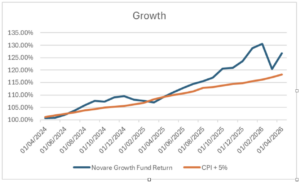
As illustrated in the accompanying graph, the strategy has consistently delivered performance in excess of its benchmark over time. In addition, the fund has demonstrated a strong focus on capital preservation, with limited drawdowns and an investment objective aimed at avoiding three consecutive months of negative returns on a rolling basis. Importantly, the results reflect the strategy’s ability to generate relative outperformance not only during positive (bull) market environments, but also through periods of market stress and negative (bear) conditions.
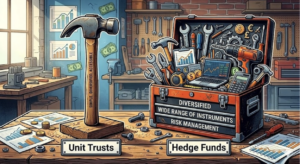
"It is tempting, if the only tool you have is a hammer, to treat everything as if it were a nail." — Abraham Maslow
Our Take
We believe that hedge funds are a valuable asset class that is often overlooked or misunderstood by investors. A comparison we frequently use to illustrate the advantage of hedge funds is that unit trust funds are like a hammer, effective at performing a specific task, but limited in their flexibility. Hedge funds, by comparison, are more like a toolbox, offering a wide range of tools and strategies that can be used to pursue returns for investors across different market environments.
Prepared by: John Henry Van der Westhuizen, Investment Analyst
Part 1 of 3

In collaboration with

For more information about this article please contact us